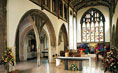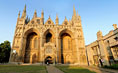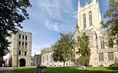
There has never been a better time to visit this medieval building, once part of the great abbey of St Edmund, as it has recently been completed with the addition of a new Gothic style lantern Tower. The Cathedral serves not only as the Parish Church of St James but also as the Mother Church of Suffolk and as such prayer is offered daily services for the local community and the world at large. It is a busy place with many staff involved in the daily running of its work and ministry. At the same time it is there for anyone to use for quiet reflection or private prayer.
For nearly 1,000 years the site of Suffolk's Cathedral has been one of worship and pilgrimage. The death of Edmund, King of the East Angles, in 869 led to the building of a Norman abbey to house the remains of the martyred monarch. Several churches were built within the precincts of the abbey. The nave of today's church is the successor of one of those churches; it was started in 1503.
Though little remains of the Benedictine Abbey, St James' Church has continued to grow over the centuries with alterations in the 18th and 19th centuries.
In 1914 St James' became the Cathedral church of the Diocese of Saint Edmundsbury and Ipswich. After the Second World War, since the late 1950s, the completion and enlargement of St Edmundsbury Cathedral has been the inspiration of Stephen Dykes Bower (1903-94) who was architect here between 1943 and 1988. Trained by F C Eden, he sought to blend seamlessly early sixteenth work with modern gothic design in a relatively plain style but supported with richly decorated ironwork, joinery and furnishings. The last 40 years has seen several additions as well as the building of the Cathedral Centre, which houses the Song School for the Cathedral Choir, the Refectory and meeting rooms. 2005 saw the Cathedral completed with the Millennium Project adding a new tower, chapels and cloisters.
Within stone and limewashed plaster walls, ceilings are vibrantly coloured panels of striking motifs, the Nave Roof decorations, all done with stencils, having been completed only in the 1980s. This effect is carried down by the handsome Font cover, a memorial of the first World war, to the Victorian tiled floor, laid in 1865. In contrast, the floors at the East end are in randomly coloured Suffolk paving.
The stained glass windows are mostly Victorian and, in the Nave, relate to the Old Testament (North side) and to the New Testament (South side).
Perhaps the most important Sculpture work in the Cathedral is the Elisabeth Frink 'Crucifixion' at the head of the Treasury stairs. Suffolk born, Miss Frink also sculpted the statue of St Edmund in the Great Churchyard, a memorial to the old West Suffolk County Council dissolved in 1973.
The individual kneelers in the Nave and Quire were created in the 1960s. The designs, based on the blue woollen cloth of the Middle Ages, from which the wealth of Suffolk was then derived, represent every parish and many other organisations in the Diocese.
Millennium Project
Thanks to grants from the Millennium Commission and the Stephen Dykes Bower Trust and the generosity of many kind people it has been possible to raise the necessary funds to undertake the final phase of building and complete the Cathedral. Building work started in 1999 and the Tower was completed in 2005.
The Gallery of the North Transept has now been completed and is open to the public. The Cloister and new chapels will be completed in the near future.
American connections - Martha's Vineyard is named after a young girl, daughter of Bartholomew Gosnold, the explorer and founder of Jamestown, who was baptised in St James church in 1597. The Cathedral and the town of Bury St Edmunds have a long and friendly relationship with the people of America.
The Cloisters have a changing programme of Art exhibitions.
The Treasury (upstairs from the North Transept) displays church plate from around the Diocese and has other interesting exhibits on show.
Discovery CentreThe Discovery Centre, adjoining the Cathedral, is especially designed for educational groups. Special themed children's trails and activities are available with Children's Guides. Educational packs also available. Please contact the Education Officer on 01284 747467.
Further information from the Touris Information Centre on 01284 764667 or www.burystedmundstourism.co.uk.
Situated on Angel Hill and next to the award-winning Abbey Gardens, which include the ruins of the former Abbey of St Edmund and historic Norman Tower, it is close other key buildings in the town such as the ivy-clad Angel Hotel, where Charles Dickens stayed and which he featured in Pickwick Papers. Take a stroll through the Great Churchyard to neighbouring St Mary's Church and the Manor House Museum, with its beautiful collection of clocks and watches, costumes and fine arts. The 200 year old Greene King brewery, which supplies many of the town's pubs, overlooks the Regency Theatre Royal that is cared for by the National Trust.
A number of special group packages are available when visiting Bury St Edmunds. All packages can be booked through the Visitors' Officer.
In the town: Moyses Hall Museum - local history museum housed in one of England's few surviving Norman houses. Collection includes items from the Murder of the Red barn, including the guilty William Corder's scalp and a book bound in his skin.
Also of interest nearby: Art Gallery, West Stow Anglo Saxon Village, Ickworth House, Park and Gardens (National Trust)
Exhibitions, concerts, organ recitals, workshops, special services and other events are all held at St Edmundsbury Cathedral. To find out details of what's on now, please visit ourSpecial Events page.